
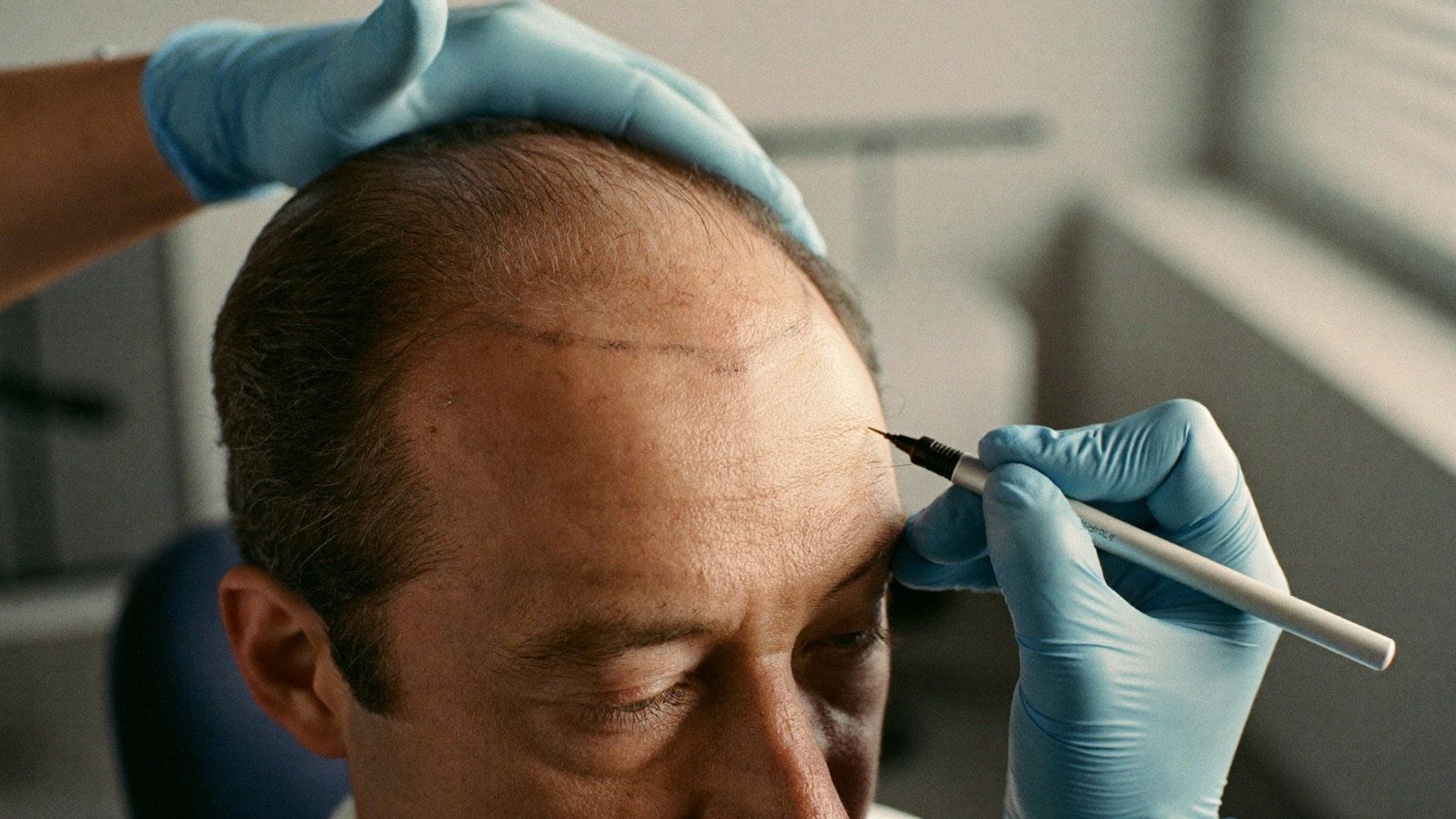
The Norwood scale is the standard system doctors use to classify male pattern hair loss, running from Stage I (no real loss) to Stage VII (extensive loss), and it is the single most useful reference point when you are trying to work out how many grafts a hair transplant would actually need. Before any clinic can give you a sensible plan, they need to know two things: where you sit on the Norwood scale today, and where your loss is likely heading. This guide explains both, and gives realistic graft ranges for each stage.
A quick caution up front: graft counts by Norwood stage are planning estimates, not fixed prices. Two men at the same stage can need very different numbers depending on their donor supply, hair characteristics, and density goals. Treat the ranges below as a way to calibrate expectations, and get a proper count from an in-person assessment before you commit to anything.
What Is the Norwood Scale?
The Norwood scale (sometimes called the Norwood-Hamilton scale) maps the typical progression of male pattern baldness into seven stages. It describes two things at once: how far loss has advanced, and the pattern it follows - usually a receding hairline and temples, thinning at the crown, or both meeting in the middle.
It matters for planning because a transplant is not simply "filling in what is gone today." A good plan accounts for where you will be in ten years, so the hairline and density still look natural as loss continues behind the transplanted area. That forward planning is why an honest surgeon sometimes places a slightly more mature hairline than a patient first asks for - it protects the result long term.
The Seven Norwood Stages
Here is what each stage looks like in practical terms:
- Stage I - no significant recession. The adolescent hairline is essentially intact.
- Stage II - slight recession at the temples, the beginnings of a mature hairline. Often not considered balding.
- Stage III - the first stage of clear balding: deeper temporal recession forming an M, U, or V shape.
- Stage III vertex - recession is modest but the crown (vertex) has started to thin.
- Stage IV - more pronounced hairline recession plus a distinct area of crown loss, with a band of hair still separating the two.
- Stage V - the band between hairline and crown narrows and thins; the two zones begin to merge.
- Stage VI - the bridge of hair between front and crown is largely gone, leaving one large area of loss.
- Stage VII - the most advanced: only a narrow band of hair remains around the sides and back.
There is also a Type A variant, where the hairline recedes straight back without a separate crown bald spot. It tends to need its front-to-back planning handled differently, since loss advances as a single receding front rather than two zones.
How Many Grafts Each Norwood Stage Typically Needs
These ranges reflect typical FUE planning for a natural, balanced result. Your actual number depends on donor density and goals - see the next section for why.
Roughly 800 to 2,000 grafts. This is mostly hairline and temple work - rebuilding the front framing of the face. Donor supply is rarely a constraint at this stage, which gives the most flexibility for the future.
Roughly 2,000 to 3,500 grafts. Covering both a receding hairline and a thinning crown, or a merging mid-scalp, takes noticeably more grafts, and the plan has to balance the front against the crown rather than spending everything on one zone.
Often 3,500 to 5,000-plus grafts, sometimes across two sessions. At this point demand can approach or exceed what the donor area can safely supply, so planning shifts to prioritising the areas that frame the face and manage expectations about full crown coverage.
If you want to understand how these graft counts translate into pricing, our Toronto hair transplant cost guide explains why clinics quote by graft count after an assessment rather than offering a flat fee.
Why Graft Counts Are Estimates, Not Guarantees
The same Norwood stage can call for very different numbers between two people. A handful of factors move the estimate:
- Donor supply - the density and total reserve of hair at the back and sides sets a hard ceiling on what can be moved. A strong donor area allows a fuller plan; a limited one means prioritising.
- Hair characteristics - coarse, wavy, or lighter hair against a similar skin tone gives the impression of more coverage per graft than fine, dark hair on pale skin.
- Density goals - restoring a natural, age-appropriate density needs fewer grafts than chasing the thickness of a teenager, which may not be realistic or wise with a finite supply.
- Future loss - grafts sometimes have to be held in reserve for areas likely to thin later, rather than used all at once.
Be cautious of any clinic that quotes a graft count before examining your scalp. A number given over the phone or from a single photo is a sales figure, not a plan. The count should come after someone has measured your donor density and looked at your loss pattern in person.
How Hair Loss Progresses - and Why Timing Matters
Male pattern loss is driven largely by genetics and the effect of DHT, a hormone that gradually shrinks vulnerable follicles until they stop producing visible hair. The Norwood scale captures snapshots of that process, but the speed and final extent vary enormously from person to person. Some men drift from Stage II to Stage III over a decade; others move through several stages in a few years.
This progression is exactly why timing and planning matter so much for a transplant. If you treat only what is visibly gone today and loss continues behind the transplanted zone, you can end up with an island of transplanted hair and a new bald patch behind it - a result that looks less natural over time, not more. A sound plan anticipates that.
Two practical points follow. First, stabilising ongoing loss with medical therapy, where appropriate, can protect the hair you still have and make a transplant plan more durable - which is why many surgeons discuss it alongside surgery rather than instead of it. Second, a younger patient with aggressive early loss is often planned more conservatively, because the surgeon is budgeting a finite donor supply across decades rather than a single procedure. None of this shows up in a Norwood number alone, which is the core reason the scale is a starting point for the conversation, not the conclusion of it.
The Norwood Scale and Women
The Norwood scale describes male pattern loss and does not fit the way most women lose hair. Female pattern loss is usually diffuse thinning across the top of the scalp with the frontal hairline preserved, which is why it is graded on the Ludwig scale instead. The planning, candidacy, and technique differ accordingly - our guide to female hair restoration in Toronto covers how women's cases are assessed and what options exist.
From a Norwood Stage to a Real Plan
Knowing your stage is the start, not the answer. The stage tells a surgeon roughly how much ground there is to cover; the plan comes from combining that with your donor supply, hair type, and what you want the result to do. The technique matters too - if you are weighing your options, our FUE hair transplant guide explains the method most Toronto patients choose, and if you are still comparing where to have it done, our comparison of a hair transplant in Toronto versus Turkey covers the trade-offs of local versus abroad.
The practical next step is simple: an assessment that measures your donor density, confirms your Norwood stage, and turns it into a graft count and a plan you can actually rely on - not a number pulled from a chart. That session is also the point to raise the questions the scale cannot answer for you: whether medical therapy should run alongside surgery, how your donor supply should be budgeted over the long term, and what a natural, age-appropriate result looks like for your face specifically. Walking in with your Norwood stage in mind simply means the conversation starts further ahead.
Frequently Asked Questions
Find Out Your Norwood Stage and Graft Count
Dr. Martin Jugenburg (FRCSC) will confirm your Norwood stage, measure your donor density, and turn it into a realistic graft count and plan - free, with no obligation.