
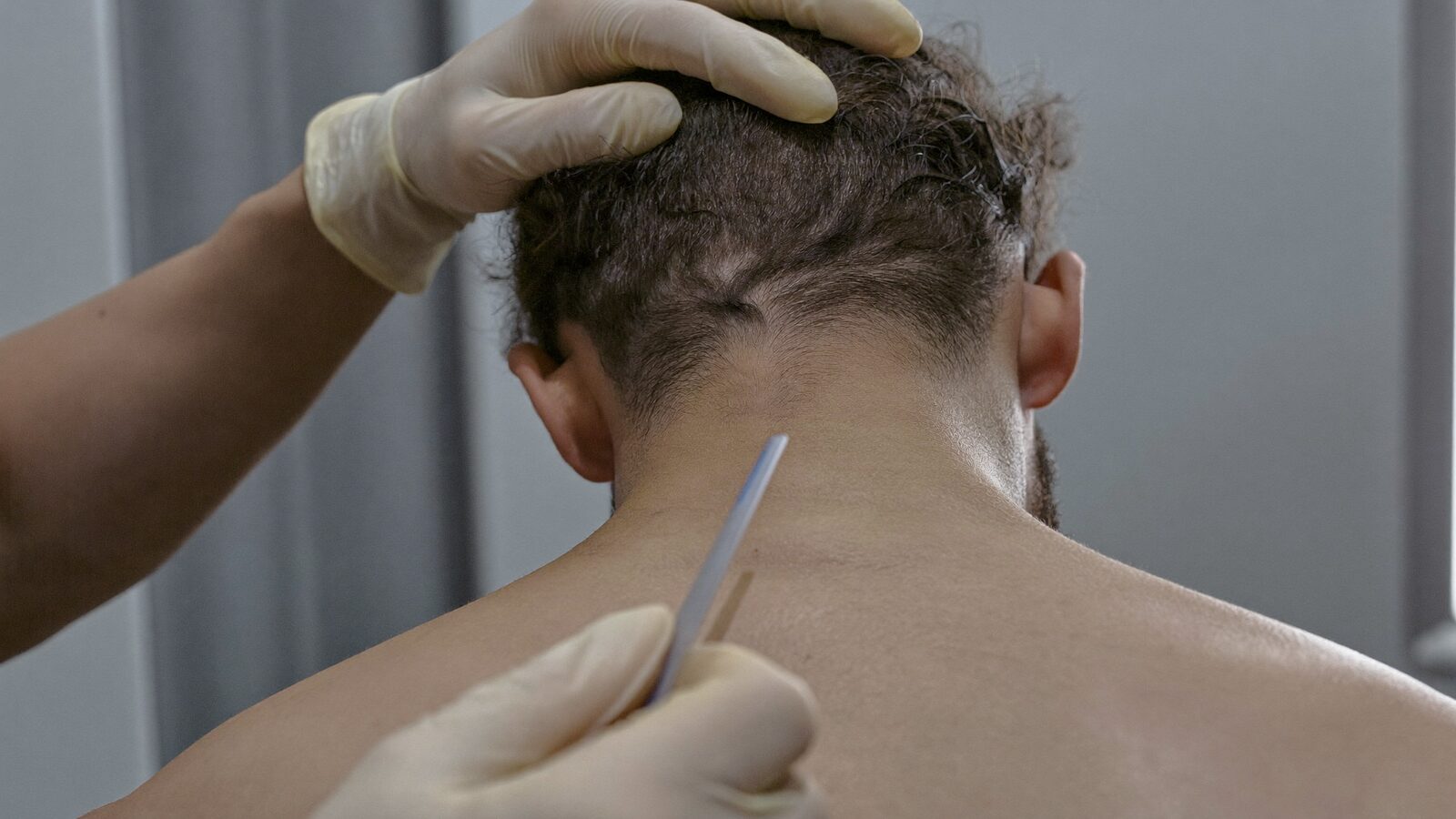
If you are researching a hair transplant, one question comes up before almost any other: how many grafts do you need? It is the number that shapes your result, your plan, and your cost - and it is also the figure that gets thrown around most carelessly online. A “3,000 graft” or “4,000 graft” headline means very little on its own, because the right count depends on your pattern of loss, how much donor hair you have to work with, and what you actually want to achieve. This guide explains how graft counts are decided, what a number like 3,000 grafts realistically covers, why a bigger count is not automatically a better result, why overharvesting is something to avoid, and what a realistic success rate actually looks like.
How Many Grafts Do You Actually Need?
First, a quick definition. A graft is a follicular unit - a natural grouping of one to four hairs as it grows out of the scalp. So a graft count is not the same as a hair count; 3,000 grafts might carry roughly 6,000 to 7,000 individual hairs depending on your follicular grouping. When clinics talk about the size of a procedure, they count grafts, because grafts are what gets extracted and placed.
The number you need is driven by four things: how advanced your loss is, how much healthy donor hair you have at the back and sides, the density you want to rebuild, and your hair characteristics (calibre, curl, and how closely your hair colour matches your skin). Where you sit on the Norwood scale of hair loss is the usual starting point for estimating the count, because it describes both how much area needs coverage and where that area sits.
A rough rule of thumb many clinics use is that a thinning or balding zone about the size of a clenched fist needs somewhere around 1,200 to 1,500 grafts to look natural. Scale that up by how many fist-sized zones you want addressed and you get a planning estimate. Broadly:
- Early loss (a receding hairline and temples): often around 800 to 2,000 grafts.
- Moderate loss (hairline plus a thinning crown or mid-scalp): often around 2,000 to 3,500 grafts.
- Advanced loss (most of the top of the scalp): frequently 3,500 to 5,000 or more, sometimes staged across two sessions.
Be cautious of any clinic that quotes you a graft count before examining your scalp. A figure given over the phone or from a single photo is a sales number, not a plan. A real count comes only after someone has measured your donor density and studied your loss pattern in person.
What Will 3,000 Grafts Cover on Your Head?
Three thousand grafts is one of the more common session sizes, which is exactly why people search for what it covers. The honest answer is “it depends on the area and the density you spread it over,” but some useful reference points help. Natural hair grows at roughly 80 to 100 follicular units per square centimetre. A transplant does not try to match that - a natural-looking restoration usually aims for around 30 to 45 units per square centimetre, because that is enough to give the visual impression of fullness without exhausting the donor supply.
Spread at that density, 3,000 grafts covers a meaningful area, but it is a budget you have to allocate rather than an unlimited supply. Here is how the same 3,000 grafts might be used very differently:
Concentrated on the front, 3,000 grafts can rebuild a receding hairline and the frontal zone that frames the face at a solid, natural density - the change people notice most.
Spread across the front and mid-scalp, the same count gives broader coverage at a slightly lower density - good for moderate loss where the whole top needs lifting rather than one zone maximised.
The crown is a spiral that visually “drinks” grafts. Trying to cover hairline, mid-scalp and crown with 3,000 grafts usually means thin coverage everywhere - which is why advanced cases are often staged.
So 3,000 grafts is a lot - but it is not infinite. A good plan decides, with you, where that coverage will have the biggest visual payoff rather than trying to spread it so thin that nowhere looks full.
What Affects the Cost of a 3,000-Graft Hair Transplant?
We do not quote exact prices in a guide like this, because a responsible figure only comes after an assessment - but it is fair to explain what actually moves the cost so you can read any quote critically. The main factors are the number of grafts, the technique, the number of sessions your plan needs, and the complexity of your case.
Technique matters because the methods differ in how labour-intensive they are. FUE in Toronto extracts follicular units individually and leaves no linear scar, which is more time-consuming per graft than the older strip method; DHI uses a specialised implanter for placement. The more meticulous the extraction and placement, the more surgical time each graft represents. Session count matters too: staging a large case across two sessions adds to the total compared with a single smaller procedure.
A word of caution on “per graft” advertising: a low per-graft figure can look cheaper while the plan quietly inflates the graft count, and a rock-bottom overseas quote often leaves out travel, revisions, and the cost of correcting an over-harvested donor later. For how pricing is actually structured here - by treatment area, with financing options - see our hair transplant cost guide for Toronto, and treat any written estimate as the output of a real assessment rather than a sticker price.
Is 4,000 Grafts Too Much? Understanding Overharvesting
This is where more is not automatically better. Your donor area - the band at the back and sides of the head - holds a finite, DHT-resistant supply of hair. Across a lifetime, most people can safely give up somewhere in the region of 6,000 to 8,000 grafts total, and that reserve has to last for every procedure you may ever have, including future touch-ups as native hair keeps thinning.
“Overharvesting” is what happens when a clinic takes too many grafts from the donor in pursuit of a big headline number. Pushed too far, it leaves the back and sides looking thin, patchy, or see-through, sometimes with visible scarring - damage that is difficult or impossible to reverse, because the donor does not regenerate. A 4,000-graft session is entirely appropriate for the right candidate with a strong donor; for someone with a modest donor supply, chasing that same number can permanently compromise the very area the whole procedure depends on.
Nova Medical Hair Transplant does not overharvest grafts. We plan every case around what the donor can safely give - preserving the density of the back and sides, extracting in a distributed pattern, and recommending a more conservative count or a staged plan when that protects your long-term donor supply. If a realistic plan means fewer grafts than you were hoping for, we will tell you that honestly rather than take hair you cannot afford to lose.
The goal is a result that still looks natural up close in ten and twenty years - not the largest possible number on day one.
Hair Transplant Success Rates: What Are Your Real Odds?
“Success” in a hair transplant really means three things together: a high proportion of the transplanted grafts survive and grow, the result looks natural, and it lasts. On graft survival specifically, modern follicular-unit techniques in experienced hands typically achieve high take rates - commonly cited in the region of 90 to 95 percent when grafts are handled well. What moves that number up or down is largely in the planning and the execution: how gently grafts are extracted, how little time they spend outside the body, how carefully they are placed, how suitable a candidate you are, and how closely you follow aftercare in the first days.
Realistic timing matters as much as the headline rate. Transplanted hairs usually shed within the first few weeks - this is normal and expected - then regrow from around three to four months, thicken noticeably by nine to twelve months, and reach their final look by roughly twelve to eighteen months. Transplanted follicles are taken from DHT-resistant zones, so they are permanent; but the native hair around them can keep thinning, which is why a good plan accounts for future loss rather than just today’s pattern. No ethical clinic guarantees a specific outcome - biology varies - but a well-planned, well-executed procedure on a suitable candidate has strong, predictable odds.
How We Plan Your Graft Count at Nova Medical Toronto
At our hair transplant clinic in Toronto, the graft count is the output of an assessment, not the starting pitch. Dr. Martin Jugenburg (FRCSC) oversees the evaluation: measuring your donor density, mapping your current loss and where it is likely heading, discussing what matters most to you visually, and then translating all of that into a graft count and a written plan. Because the donor is finite, that plan is deliberately donor-first - it protects your long-term supply, is honest about what one session can and cannot achieve, and stages larger cases when staging gives the better and safer result.
That is also the only way to turn the ranges in this article into a number that actually applies to you. A chart can tell you that moderate loss often needs 2,000 to 3,500 grafts; only an in-person assessment can tell you where in that range you sit, whether your donor can support it, and what the realistic coverage will look like.
Find Out How Many Grafts You Actually Need
Dr. Martin Jugenburg (FRCSC) will measure your donor density, map your loss, and turn it into a realistic graft count and plan - donor-first, with no overharvesting and no obligation.