
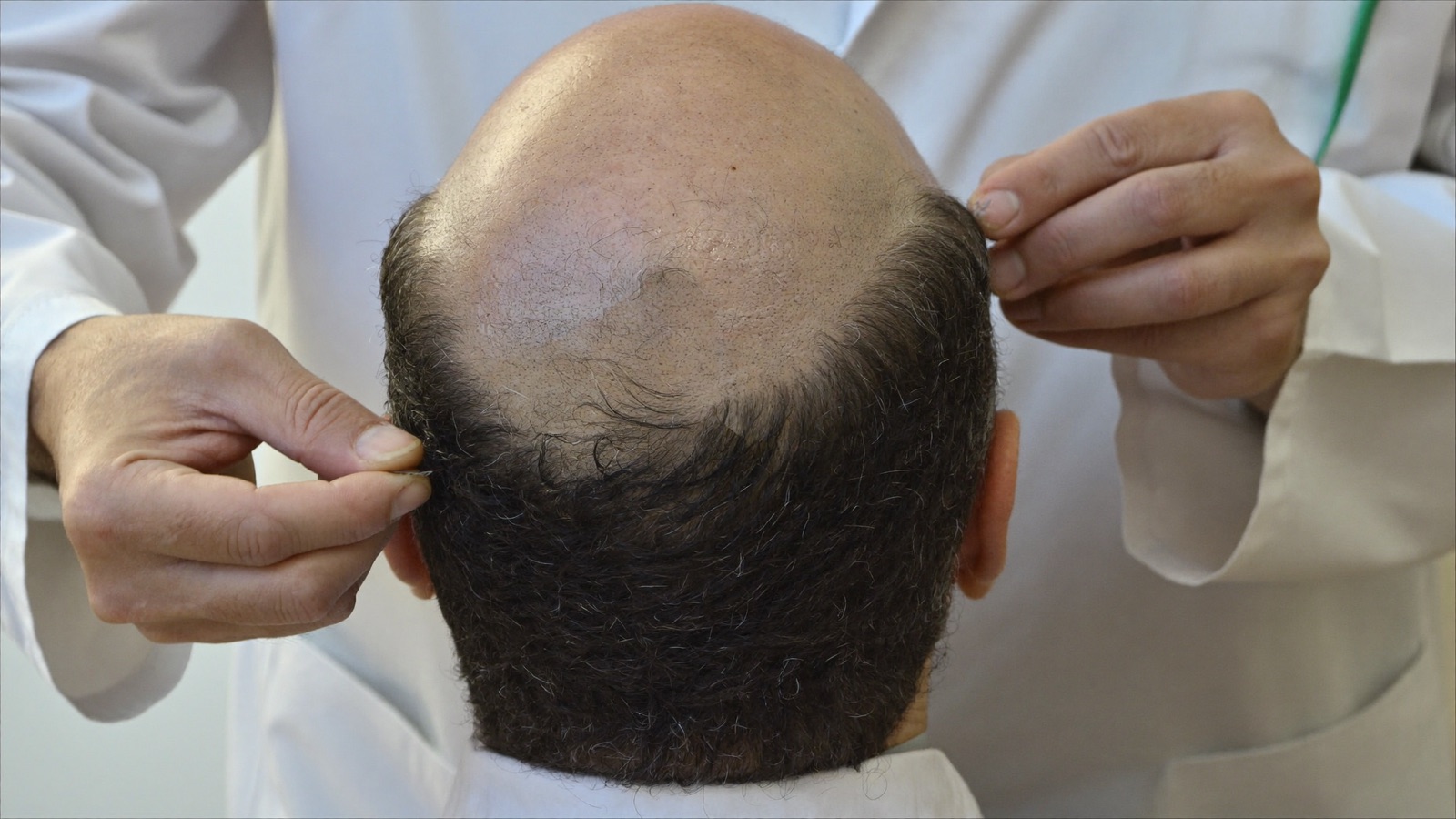
If you are already bald on top, you may have been told that a hair transplant is out of the question, or you may have seen clinics promise a full head of hair regardless. The truth sits between those two extremes. A hair transplant when bald is possible for some people and not for others, and the deciding factor is not how bald you are on top but how much healthy hair remains around the back and sides. This guide explains how donor supply shapes what is possible, what a realistic plan looks like, the limits of body hair, when combination approaches make sense, and when surgery is not the right answer.
Can You Get a Hair Transplant When You Are Bald?
The short answer: you can often get a hair transplant when bald on top, as long as the hair at the back and sides of your head is dense and healthy. That donor area supplies every graft. If it is strong, a surgeon can usually rebuild a natural hairline and frontal coverage. Full coverage of a completely bald scalp is rarely realistic, and if the donor area is thin, surgery may not be appropriate at all.
This is one of the most important topics to approach honestly, because people who are bald on top are often the most vulnerable to unrealistic promises. A large bald area can absorb an almost unlimited number of grafts, but no donor area can supply an unlimited number. The goal is to use what is available where it makes the biggest difference.
Being bald on top is different from having advanced but still partial thinning. If you still have some hair across the top, our guide to whether it is too late for a hair transplant covers planning at Norwood 5, 6 and 7 in more detail. This article focuses on people whose top and crown are largely or completely bald.
The Donor Area Is the Whole Story
Every hair transplant moves follicles from the donor area to the recipient area. In male pattern baldness, the donor area is the horseshoe-shaped band of hair at the back and sides of the head that is genetically resistant to the hormone that causes pattern loss. Hair taken from there keeps growing after it is moved.
Surgeons assess several things in that band:
- Density: how many follicular units grow per square centimetre.
- Width and height: how large the safe zone is from ear to ear and from the neck upward.
- Follicular unit size: how many hairs grow from each unit, since units of two or three hairs give more coverage per graft.
- Hair characteristics: calibre, curl and colour contrast, which affect how full a given number of grafts looks.
- Stability: whether the band itself shows any signs of thinning.
Because this supply is finite, it has to be managed carefully. Taking too many grafts leaves the back and sides visibly thin and patchy, which creates a second cosmetic problem. Nova Medical does not overharvest grafts. Bald patients are the group most often overharvested elsewhere, because the bald area is so large, so we are explicit that the plan is limited by what the donor area can give while still looking natural.
Why Fully Bald Is Different From Advanced Thinning
When some native hair remains on top, transplanted grafts can be placed among it, and the combination adds up to a fuller look. When the top is completely bald, every hair you see in the treated area must come from a graft. That means more grafts are needed to achieve the same visual density.
Fully bald patients also often have a smaller donor band, because the same genetic process that caused extensive loss on top may have narrowed the safe zone at the sides. The combination of a larger area to cover and a smaller supply is why expectations need careful management.
| Donor area | What is usually achievable | What is usually not achievable |
| Dense and broad | A natural, mature hairline and good frontal coverage, possibly extending toward the mid-scalp over two sessions | Full density across the entire top and crown |
| Moderate | A framing hairline and lighter frontal coverage | Coverage of the crown, or high density anywhere |
| Thin or narrow | Possibly a small, targeted procedure, often combined with scalp micropigmentation | Any substantial coverage without depleting the donor area |
| Thinning or unstable | Usually no surgical option; non-surgical approaches preferred | Permanent results from transplanted hair |
What a Realistic Plan Looks Like: Frontal Framing
For most bald patients who are candidates, the plan focuses on framing the face. The hairline and the area just behind it have more effect on appearance than any other part of the scalp. Restoring them gives a strong visual result even if the crown remains bald.
The hairline is usually set at a mature, age-appropriate height with a soft, irregular edge. A higher hairline uses fewer grafts, looks natural on an adult face and leaves supply available for future needs. Density is highest at the front and gradually reduces further back, which creates the appearance of fullness from the front and sides.
The FUE hair transplant technique is commonly used, extracting follicles one at a time from the donor band. A plan might be carried out in one session or staged over two, with the second session added once the first has grown in, usually after about a year. Our article on how many grafts you need explains how graft numbers relate to coverage.
Body Hair as a Donor Source: What It Can and Cannot Do
Patients with a limited scalp donor area sometimes ask about using body hair, such as beard or chest hair. This is possible in some cases, but it has real limitations.
Beard hair is usually the most useful body donor source. It is often thick and can blend reasonably well when placed behind the hairline or in the crown, where it adds bulk. Chest and other body hair tends to be finer, grows in shorter cycles and often does not match scalp hair in texture, length or angle. It is rarely suitable for the hairline.
Body hair transplants are also slower and more technically demanding, and results are less predictable than with scalp hair. For most people they are, at most, a supplement to a scalp donor area rather than a replacement for one. A surgeon will only suggest it after assessing whether it is genuinely likely to help.
Scalp Micropigmentation and Combination Approaches
Scalp micropigmentation is a cosmetic tattooing technique that places tiny dots of pigment in the scalp to recreate the look of closely shaved hair. It is not a hair transplant and does not grow hair, but it can be very effective for bald patients who like a short, buzzed style.
Some patients combine the two. A transplant can rebuild a natural hairline and some frontal density, while micropigmentation adds the appearance of density to areas the grafts cannot cover. Others choose micropigmentation alone, particularly when the donor area is limited. The right choice depends on how you prefer to wear your hair and on what your donor area allows.
How the Result Develops for Bald Patients
The growth timeline is the same as for any hair transplant, but it can feel longer when you start from a fully bald scalp, because there is no native hair to soften the early stages. In the first two weeks, the treated area is red and scabbed. Between roughly weeks two and eight, most transplanted hairs shed, which is normal. New growth usually begins around months three to four, becomes clearly visible by months six to eight, and continues to thicken until around twelve to eighteen months.
Bald patients also need to think about the rest of the scalp. If the crown stays bald behind a restored hairline, hairstyle choice matters. Many patients keep the back and sides slightly longer and style the transplanted front so it falls naturally. Others pair the result with micropigmentation in the crown. Medical therapy is less relevant when little native hair remains on top, but it may still be discussed to protect the donor band and any remaining thinning areas.
Because the result depends so heavily on design, the hairline is planned and marked carefully before surgery, with the long-term picture in mind.
When No Surgical Option Is Appropriate
There are situations where a hair transplant is not the right choice for a bald patient:
- The donor area is too thin or narrow to provide a natural result.
- The donor area itself is thinning, so transplanted hair may not last.
- The expectation is full coverage of an extensive bald area that no donor supply could meet.
- A medical condition makes surgery unsafe, or the hair loss has a cause other than pattern loss.
In these cases, an honest clinic will say so clearly and talk through the alternatives, which may include micropigmentation, cosmetic options or simply embracing a confident short style. A clear no based on a proper examination is far better than a procedure that cannot deliver.
Setting Expectations Before You Book a Consultation
Before an assessment, it helps to think about what matters most to you. Is it the hairline and how your face is framed? Is it the overall appearance from the front? How do you prefer to wear your hair? These answers help a surgeon design a plan that matches your priorities within the limits of your donor area.
It also helps to look at real results from patients with similar starting points. Our before and after gallery shows the kind of outcomes achievable at different stages. At our Toronto hair transplant clinic, Dr. Martin Jugenburg, a Royal College-certified plastic surgeon (FRCSC), oversees each assessment, including a close examination of the donor area and an honest discussion of what is realistic for you.
Find Out What Is Possible for You
A private assessment with Dr. Martin Jugenburg (FRCSC) examines your donor area and gives you a straight answer about whether a transplant, a combination approach or a non-surgical option suits you. No cost and no obligation.