
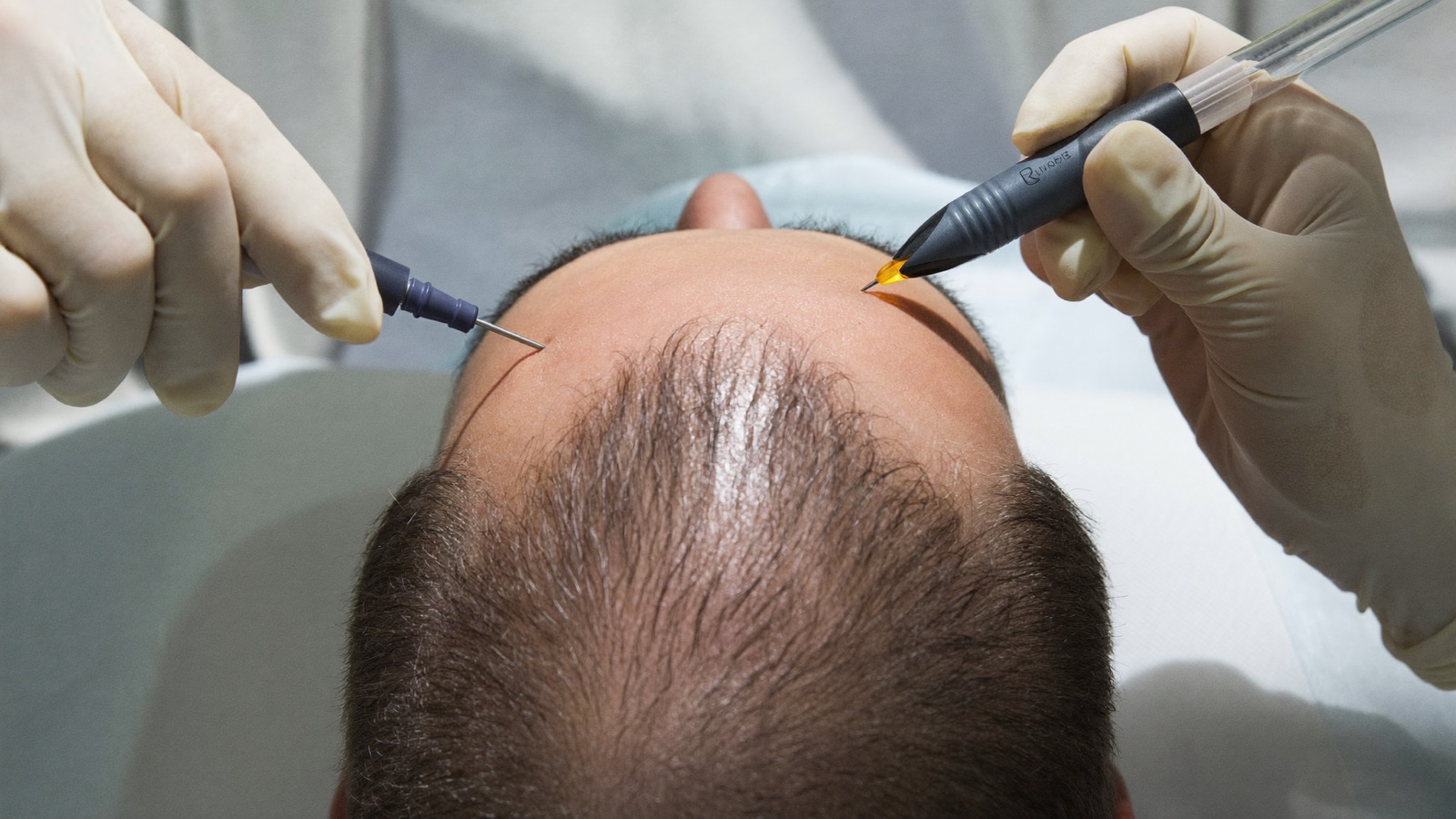
If you have started researching hair transplants, you have probably seen clinics promote robotic systems such as ARTAS alongside others that emphasise manual, hand-held extraction. Both are forms of follicular unit extraction (FUE), and both can produce natural results. The question of manual FUE vs robotic FUE is really about how each follicle is removed from the donor area, how much the process can adapt to your hair, and who is controlling it. This guide explains how each approach works, where they genuinely differ, and why the experience of the team matters more than the machine.
The Actual Difference Between Manual and Robotic FUE
The short answer: in both methods, individual follicular units are removed from the back and sides of the scalp with a small circular punch. In manual FUE, a trained clinician guides the punch by hand under magnification. In robotic FUE, a computer-guided arm identifies follicles with cameras and performs the punch movement, with staff supervising and adjusting settings.
Everything after extraction is broadly similar. The grafts still need to be sorted, kept in good condition outside the body, and placed into recipient sites that are designed by hand. A robot changes one stage of the procedure, not the whole procedure.
That point is often lost in marketing. A robotic system is a tool for harvesting grafts. It does not design the hairline, decide how many grafts your donor area can safely give, or place the grafts in a natural pattern. Those decisions are still made by people.
How Manual FUE Extraction Works
In manual extraction, the clinician uses a hand-held punch, sometimes attached to a motor that rotates or oscillates the tip, to score around each follicular unit. The punch is aligned with the angle at which the hair exits the skin and advanced only to a controlled depth. The graft is then gently freed with fine forceps.
The defining feature of manual work is continuous feedback. The clinician can feel changes in tissue resistance, see when a follicle curves beneath the skin, and adjust angle or depth from one graft to the next. That adaptability is useful where hair is curly, where angles change across the donor area, or where scar tissue from a previous procedure alters how the skin behaves.
The trade-off is that manual extraction depends heavily on the skill, concentration and stamina of the person doing it. A well-trained team working at a steady pace with good magnification can work very precisely. An inexperienced or rushed team can damage more follicles. If you want a full overview of the procedure itself, our page on FUE hair transplant in Toronto walks through each stage from planning to recovery.
How Robotic Systems Such as ARTAS Work
ARTAS is a widely known robotic system for hair restoration. It uses high-resolution cameras to map the donor area, identify individual follicular units and calculate the angle and direction of each one. A robotic arm then aligns a punch with the selected follicle and performs the scoring movement.
The system follows programmed parameters such as punch size, depth and the spacing between extractions, and the operator can adjust these during the procedure. Staff remain in the room throughout, monitoring the process, removing the scored grafts and handling them after extraction.
Robotic systems offer some genuine strengths. Their movements are consistent, they do not tire, and their spacing algorithms can help distribute extractions evenly across the donor area. For straight, dark hair with a clear contrast against the scalp, the cameras can identify follicles reliably.
Like any tool, they also have limits. The system relies on what its cameras can see, which can be harder with very light, grey or fine hair, and with hair that curves strongly beneath the skin. Most systems also need the donor area to be shaved short so the cameras can track each hair.
Manual vs Robotic FUE Side by Side
The table below summarises the practical differences. It is a general comparison, and how each one performs in a real procedure depends on the team using it and on your individual hair characteristics.
| Factor | Manual FUE | Robotic FUE (such as ARTAS) |
| Who guides the punch | A trained clinician, by hand, under magnification | A computer-guided arm, with staff supervising |
| Follicle selection | Chosen by eye, graft by graft | Chosen by camera-based algorithm within set parameters |
| Adjusting to changing angles | Immediate, based on feel and sight | Based on what the cameras detect at the surface |
| Curly, coarse or very light hair | Generally adaptable with an experienced team | Can be more challenging, depending on the case |
| Consistency over long sessions | Depends on team stamina and workflow | Mechanically consistent |
| Donor preparation | Shaved, partially shaved or unshaven options possible | Usually requires a short shave |
| Recipient site creation and placement | Done by hand | Done by hand on most systems |
| Main dependency | Skill and experience of the team | Skill of the team setting and supervising the system |
Punch Size, Angle and Depth: Where the Real Variation Lies
Whether the punch is guided by a hand or a machine, three variables determine how cleanly a follicle comes out: the size of the punch, the angle at which it enters the skin, and how deep it goes.
Punch size. Smaller punches leave smaller marks, but if a punch is too small for the follicular unit it can cut into the grafts. Larger punches give more margin but leave more visible marks and remove more tissue. The right size depends on the number of hairs in each unit and the thickness of the hair.
Angle. Hair grows out of the skin at an angle, and that angle can change slightly beneath the surface. If the punch is not aligned with the follicle, it can cut across it, a problem known as transection. Transected grafts may not grow as expected.
Depth. The punch only needs to go deep enough to free the upper part of the follicle so it can be gently extracted. Going too deep increases the risk of damaging the follicle and surrounding tissue. Not going deep enough makes extraction harder and can cause the graft to tear.
These variables are the same for manual and robotic methods. The difference is in who sets and adjusts them. In a robotic procedure, the parameters are configured and corrected by the operator. In a manual procedure, they are adjusted continuously by the clinician's hand and eye. Either way, careful judgement on these three settings has a larger effect on the grafts than the device that holds the punch.
Hair Types That Suit Each Approach, Including Curly and Coarse Hair
Your hair characteristics are one of the most useful ways to think about this comparison.
Straight, dark hair with good scalp contrast is the easiest hair type for any method. Follicles are easy to see, their angles are predictable, and both manual and robotic extraction can work well.
Curly and Afro-textured hair often curves beneath the skin, which means the visible angle at the surface does not match the path of the follicle below. Manual extraction, where the clinician can feel the resistance and adjust as the punch advances, is generally considered more adaptable for this hair type. Some surgeons use specialised punch designs for curly hair.
Coarse hair may need slightly larger punches to avoid cutting into the follicle, and the size needs to be chosen for the individual patient rather than set as a default.
Grey, white or very light hair can be harder for camera-based systems to identify against the scalp. Manual extraction relies on magnified visual inspection and does not depend on automated detection in the same way.
Previous procedures. Patients who have had a strip procedure or earlier FUE often have scar tissue in the donor area, which changes how the skin behaves. These cases usually benefit from the adaptability of manual work.
Speed Versus Selectivity
One of the claims made for robotic systems is speed. A machine can maintain a consistent extraction rhythm, which can help with large sessions. Manual extraction speed varies with the team, the hair type and the complexity of the donor area.
Speed is not the whole story, though. The more important question is selectivity: which follicles are taken, and from where. A careful harvest spreads extractions so that the donor area still looks full afterwards, avoids taking too many grafts from one zone, and favours follicular units that suit the plan. A procedure that is fast but takes grafts too densely from one area can leave the back of the head thin or patchy.
This is also where graft volume comes in. The number of grafts your donor area can safely provide is fixed by your biology, not by the extraction method. A robotic system does not create more donor supply, and neither does a manual one. Our guide to how many grafts you need explains how donor density and the size of the recipient area determine a realistic graft count. Nova Medical does not overharvest grafts, whichever extraction method is used.
Why the Operator Matters More Than the Device
Across both methods, the single biggest variable is the experience of the people involved. A robotic system is only as good as the team that sets its parameters, monitors its progress and handles the grafts it produces. A manual procedure is only as good as the hands and judgement of the clinician holding the punch.
Extraction is also only one part of a hair transplant. Hairline design, the angle and direction of recipient sites, how densely grafts are placed, and how carefully they are handled outside the body all affect how natural the result looks. None of these depend on whether extraction was manual or robotic.
When you compare clinics, it is more useful to ask about the team than about the machine. How many procedures have they performed? Who designs the hairline? Who oversees the surgery from start to finish? At our Toronto hair transplant clinic, every procedure is overseen by Dr. Martin Jugenburg, a Royal College-certified plastic surgeon (FRCSC), who directs the plan and supervises the surgical team throughout.
A useful way to frame it: the device decides how the punch moves. The team decides which follicles to take, how many, from where, and where they go. The second set of decisions has more effect on how your result looks.
What Nova Medical Uses and Why
Nova Medical uses manual extraction as part of the Nova Medical FUE Protocol. Follicles are extracted individually with a hand-held micro-punch under magnification, with the punch size, angle and depth adjusted to the patient's hair as the procedure progresses.
This approach was chosen because it adapts to a wide range of hair types, including curly, coarse, grey and previously operated donor areas, and because it allows partial-shave and unshaven options for suitable patients. After extraction, grafts are sorted and inspected under magnification and kept in chilled storage solution until they are placed, and recipient sites are created by hand at angles that follow natural growth.
This is a description of how we work, not a claim that robotic extraction is wrong. Robotic systems are used successfully by many clinics, and the right choice for you depends on your hair, your goals and the team you trust. If you are unsure, a consultation is a good place to ask how your donor area would be harvested and why.
Questions To Ask Any Clinic About Its Extraction Method
Whichever method a clinic promotes, these questions help you understand what will actually happen during your procedure:
- Who performs the extraction, and who oversees the procedure from start to finish?
- What punch sizes do you use, and how do you choose them for my hair?
- How do you adapt the technique if my hair is curly, coarse or grey?
- How many grafts do you think my donor area can safely provide, and how did you work that out?
- How are grafts stored and handled between extraction and placement?
- Who designs the hairline and creates the recipient sites?
- Will I need to shave the donor area fully, partly or not at all?
Clear, specific answers to these questions tell you far more about the likely result than the name of a device.
Not Sure Which Approach Suits Your Hair?
A private assessment with Dr. Martin Jugenburg (FRCSC) looks at your donor area, hair type and goals, and explains how extraction would be planned in your case. No cost and no obligation.