
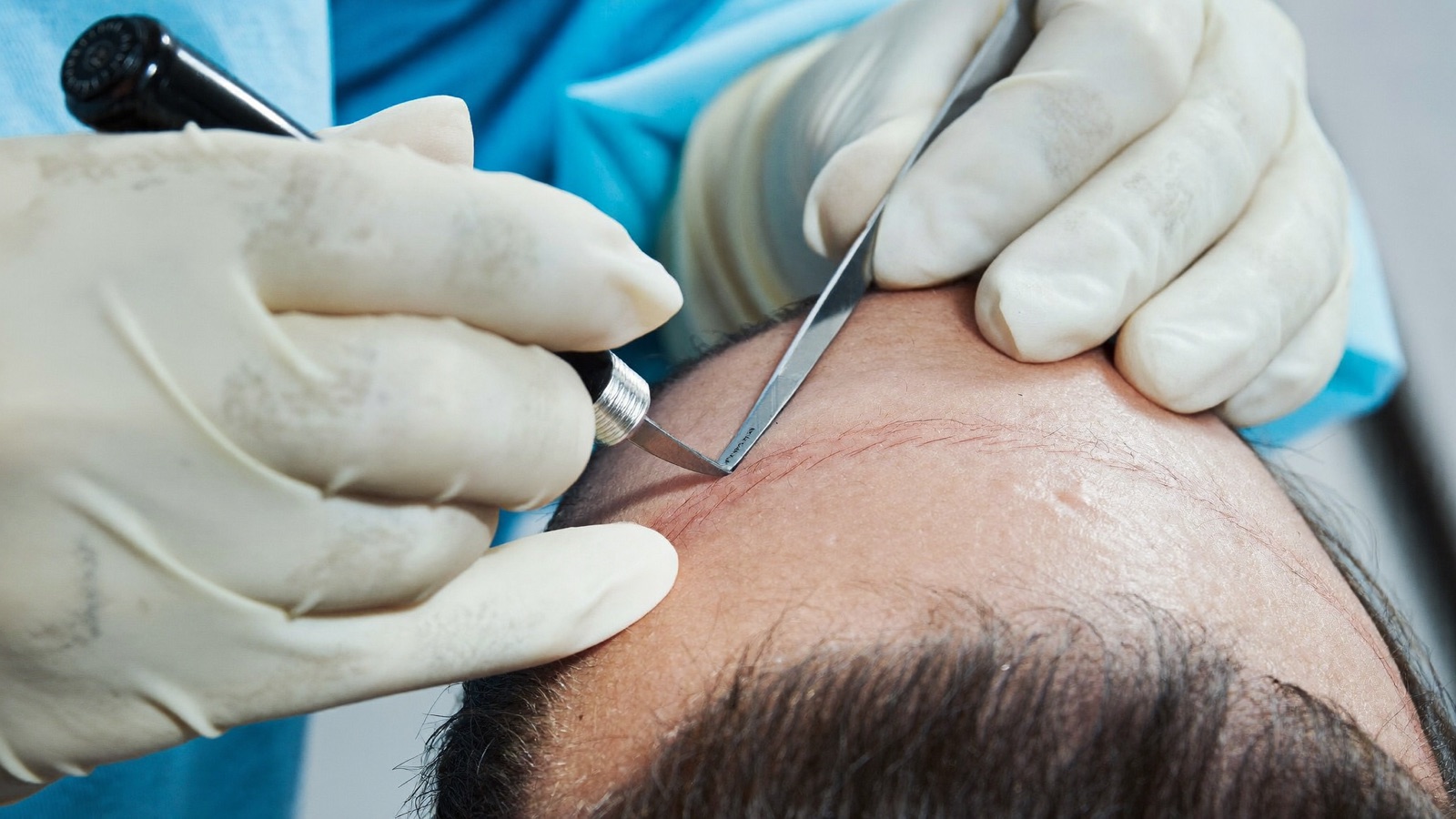
Sapphire FUE is one of the most heavily promoted terms in hair restoration, particularly by clinics abroad. It is often presented as a newer, more advanced kind of hair transplant. In reality, sapphire FUE refers to a single tool used at one stage of the procedure: the blade that creates the small openings where grafts are placed. This guide explains what sapphire FUE actually is, what the evidence does and does not support, and which parts of a procedure have a much larger effect on how natural your result looks.
What Sapphire FUE Actually Is
The short answer: sapphire FUE is a standard FUE hair transplant in which the recipient sites, the tiny incisions that receive the grafts, are made with a blade tipped with synthetic sapphire rather than steel. Extraction, graft handling and placement are the same as in any FUE procedure. Blade material is a minor variable, not a different operation.
The sapphire used is a manufactured crystal that can be shaped into a very fine, smooth cutting edge. Blades made this way are sometimes described as V-shaped or U-shaped, and they are used in the same way as steel blades or fine needles: to open small channels in the scalp at a chosen angle and depth.
Because the label sounds premium, it is easy to assume that a sapphire procedure is fundamentally different from a standard one. It is not. If you would like a full overview of how an FUE procedure works from start to finish, see our page on FUE hair transplant in Toronto.
Where the Blade Is Used: Recipient Site Creation, Not Extraction
An FUE hair transplant has three main stages. First, follicular units are extracted from the donor area at the back and sides of the head with a small circular punch. Second, small openings called recipient sites are made in the area being restored. Third, the grafts are placed into those openings.
The sapphire blade is used only in the second stage. It plays no part in removing grafts from the donor area, so it has no effect on how cleanly follicles are extracted, how many grafts your donor area can provide, or how the donor area heals.
This matters because some marketing implies that sapphire improves the whole procedure. In practice, it affects one step. That step is important, because recipient site design determines the direction, angle and density of the transplanted hair, but the material of the blade is only one small part of how that step is carried out.
Sapphire Versus Steel: The Claimed Advantages
Clinics that promote sapphire FUE usually make some combination of the following claims:
- A sharper, smoother edge that cuts more cleanly through the skin.
- Smaller incisions, which may allow grafts to be placed closer together.
- Less trauma to surrounding tissue, leading to less swelling and redness.
- Faster healing of the recipient area.
- Higher density because of tighter placement.
Some of these claims have a plausible basis. Sapphire can hold a very fine edge, and a finer edge can make cleaner incisions. However, steel blades and fine needles can also be made very small and very sharp, and many experienced surgeons use them with excellent results. The question is how much difference the material makes once a skilled team is choosing the right blade size, angle and depth.
What the Evidence Supports and What It Does Not
Published research comparing sapphire blades with steel blades for hair restoration is limited. There are few large, well-controlled studies, and much of the information available comes from clinic marketing or small case series rather than independent trials. That does not mean sapphire blades have no benefits. It means the size of any benefit has not been clearly established.
| Marketing claim | What is reasonable to say |
| Sapphire is a new type of hair transplant | It is standard FUE with a different blade used for recipient sites only. |
| Sapphire blades are sharper | They can hold a very fine edge. Well-made steel blades and needles are also very sharp. |
| Sapphire means faster healing | Smaller, cleaner incisions may heal slightly faster, but incision size and technique matter more than material. |
| Sapphire gives higher density | Density depends on donor supply, graft count and planning. A blade cannot add grafts. |
| Sapphire improves graft survival | There is no strong independent evidence that blade material alone changes how many grafts grow. |
| Sapphire leaves less scarring | Recipient sites heal without visible scars in either case when done well. Donor scarring is unrelated to the blade. |
The honest position is that sapphire blades are a reasonable tool that some surgeons prefer, and that the material is a minor variable compared with how the incisions are planned and made.
Why Incision Angle, Depth and Density Matter More Than Blade Material
Every recipient site makes three decisions about the hair that will grow from it: which direction it will point, at what angle it will leave the skin, and how close it will sit to its neighbours. These decisions shape whether a result looks natural.
Angle and direction. Natural hair grows at a shallow angle, particularly along the hairline and temples, and changes direction across the scalp. If recipient sites are made too upright or in the wrong direction, the transplanted hair will stick out or lie unnaturally, whatever the blade is made of.
Depth. Each site needs to be deep enough to hold the graft comfortably, but not so deep that it damages the tissue below or causes the graft to sit too low. Matching depth to graft length is a matter of measurement and care.
Size. The incision should be matched to the size of each graft. Single-hair grafts along the hairline need smaller sites than multi-hair grafts behind it. Oversized incisions can cause grafts to sit loosely; undersized ones can damage grafts during placement.
Density and distribution. Placing grafts too densely in one area can compromise blood supply and growth, while placing them too sparsely looks thin. Distributing them in a natural, irregular pattern, with finer grafts at the front, avoids the uniform, pluggy look of older procedures.
All of these depend on the planning and skill of the team. A carefully designed procedure with steel blades or needles will look far more natural than a poorly planned procedure with sapphire blades.
What Recipient Site Healing Looks Like in Practice
Because the sapphire blade only affects the recipient area, it helps to know what normal healing there looks like, whichever blade is used. In the first few days, the treated area usually shows small red dots or tiny crusts where each graft sits, along with some redness and mild swelling that can extend to the forehead.
Most of the small crusts soften and wash away by around day ten to fourteen with gentle cleansing. Redness usually fades over the following weeks, a little faster in people with darker skin tones and sometimes more slowly in people with very fair skin. These timelines depend far more on how many grafts were placed, how densely they were packed and how the incisions were made than on the blade material.
Between roughly weeks two and eight, most of the transplanted hairs shed. This is expected and does not mean the grafts have failed. New growth usually begins around months three to four and continues to thicken and mature for twelve to eighteen months. If a clinic suggests that sapphire blades change this growth timeline, it is worth asking what that claim is based on.
How Marketing Uses the Sapphire Label
The sapphire label is attractive for marketing because it sounds premium and technical, and because it is easy to explain in a single line. It is especially common in package-style offers from high-volume clinics abroad, where procedures are sold on features rather than on who is doing the work.
Common patterns include presenting sapphire FUE as a separate procedure with its own name, implying that standard FUE is outdated, and pairing the sapphire label with very high graft counts or guaranteed density. When a technique name becomes the main selling point, it can distract from more important questions, such as who will perform each stage of the surgery and how many grafts your donor area can safely provide. Our comparison of hair transplants in Toronto versus Turkey looks at how these package offers compare in practice.
Sapphire is one of several device and technique labels that clinics use to differentiate themselves. The same principle applies to extraction tools, which we cover in our guide to manual FUE versus robotic FUE: the tool matters less than the people using it.
Questions To Ask If a Clinic Leads With Sapphire
If a clinic emphasises sapphire FUE, these questions will help you understand what you are actually being offered:
- Which stage of the procedure uses the sapphire blade, and who makes the incisions?
- How do you decide incision size, angle and direction for my hairline?
- Who designs the hairline, and will I see the design before the procedure?
- Who extracts the grafts, and who places them?
- How many grafts do you recommend for me, and how many can my donor area safely provide?
- How are grafts stored and handled between extraction and placement?
- Who oversees the procedure from start to finish, and what are their qualifications?
A clinic that answers these questions clearly is giving you useful information. A clinic that returns to the blade material when asked about planning or staffing is telling you something too.
What To Prioritise When Comparing Clinics
When you compare options, the following factors have a much greater effect on your result than blade material:
- Who oversees the procedure. Look for a qualified physician who directs the plan and supervises the team throughout.
- Donor management. A plan that respects the limits of your donor area protects your appearance now and leaves options for the future. Nova Medical does not overharvest grafts.
- Hairline design. An age-appropriate, natural hairline that suits your face is worth more than any device feature.
- Graft handling. How grafts are kept between extraction and placement affects their condition.
- Before and after results. Look at real results from the team that will treat you, ideally from patients with hair like yours.
- Aftercare and follow-up. Clear guidance and access to the clinic during recovery matter.
At Nova Medical, recipient sites are created as part of the Nova Medical FUE Protocol, with blade angles customised to follow the natural emergence pattern of your hair and slit orientation chosen zone by zone. The focus is on angle, depth, size and distribution, because those are the variables that shape how natural the result looks. Every procedure is overseen by Dr. Martin Jugenburg, a Royal College-certified plastic surgeon (FRCSC).
The bottom line: sapphire blades are a legitimate tool, not a different procedure. If a clinic you trust prefers them, that is fine. If a clinic leads with the blade instead of the team, the plan and the donor strategy, it is worth asking more questions.
Want To Understand How Your Procedure Would Be Planned?
A private assessment with Dr. Martin Jugenburg (FRCSC) covers your donor area, hairline design and how recipient sites would be created for your hair type. No cost and no obligation.