
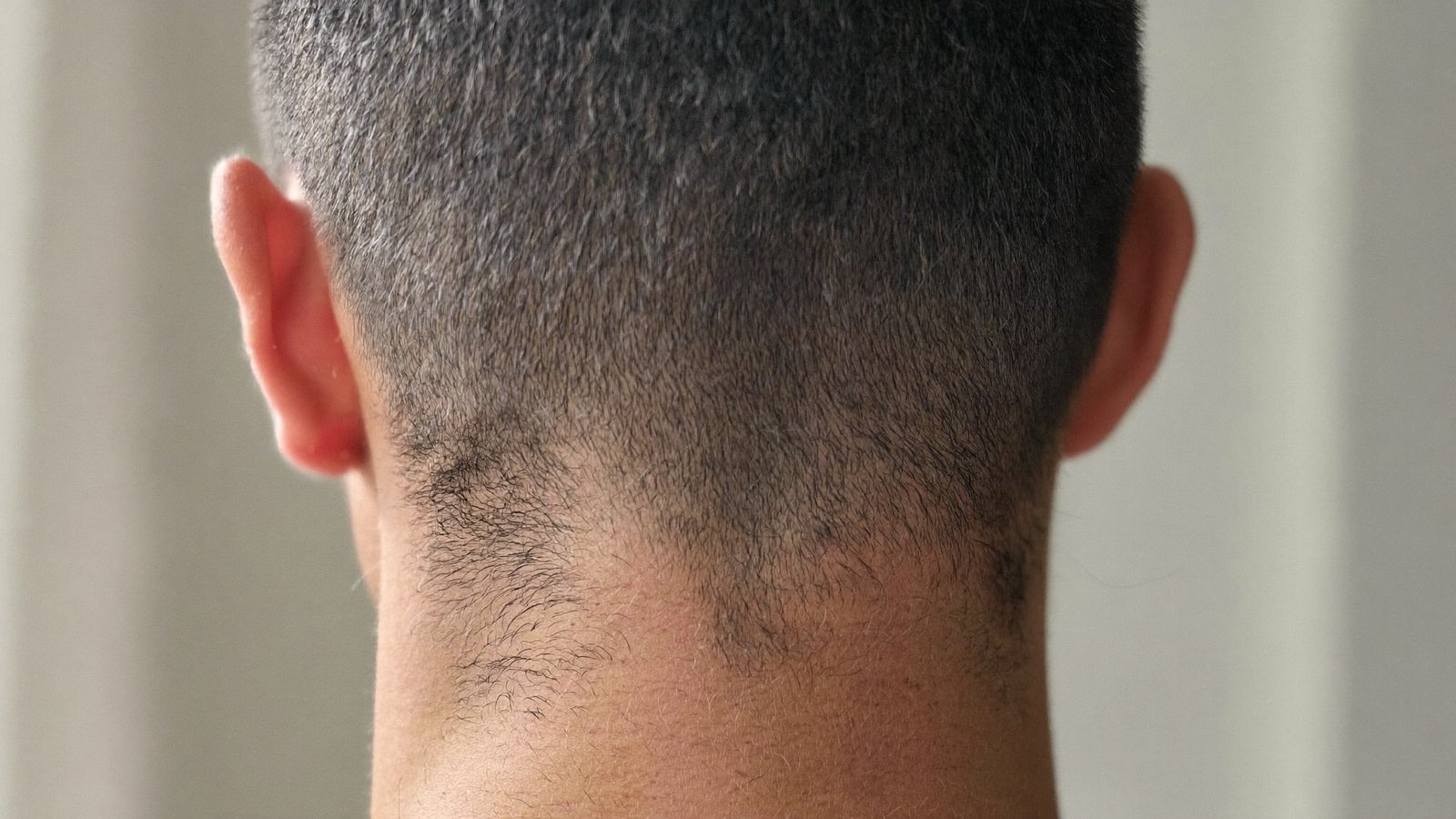
All surgery leaves scars, and hair transplant scars are no exception. The real question is how visible they will be at the hairstyle you actually wear. FUE leaves many tiny, round dot scars spread across the donor area, while FUT leaves a single fine line hidden in the hair at the back of the head. With careful planning, both are usually hard to see at most hair lengths.
This guide explains what each type of scarring looks like, how visible it is at different hair lengths, what makes scarring worse, and how it is kept to a minimum during planning and surgery. It also covers what can be done about scars from an earlier procedure. The aim is a factual comparison: both methods have a place, and the right choice depends on your hair, your goals and how short you like to keep it.
What Scarring Actually Looks Like After Each Method
After FUE, scarring is a scatter of tiny, pale dots, each roughly the size of the punch used to remove a graft, spread across the donor area at the back and sides. After FUT, scarring is a single horizontal line across the back of the head where a strip of skin was removed and closed. Neither method is scarless, and anyone who promises otherwise is not being accurate.
How noticeable either one is depends mostly on hair length, hair colour against skin tone, how well the skin heals and how carefully the donor area was managed. The table below sets out the main differences.
| Feature | FUE scarring | FUT scarring |
| Shape | Many small, round dots | One linear scar |
| Location | Spread across the donor area | Across the back of the head, ear to ear in larger cases |
| Typical appearance when healed | Pale pinpoints, often blending into short hair | A fine line, hidden by hair above it |
| Hair length that can hide it | Usually short clipper lengths | Usually longer than a very short buzz |
| Can it be revised later? | Dots can often be camouflaged | Can sometimes be improved or camouflaged |
FUE: Dot Scarring and How It Disperses
With FUE, each follicular unit is removed individually with a small round punch, leaving a tiny wound that heals as a pale dot. Because the dots are spread across a wide area rather than concentrated in one place, they tend to disperse visually among the surrounding hair, which is why FUE is often chosen by people who keep their hair short.
Dot scars are not invisible, though. On a very close shave, with a razor or the shortest clipper guard, many people can see a fine speckled pattern, especially if the skin is pale and the hair is dark. The size of the punch, the spacing between extractions and how many grafts were taken all affect how noticeable the pattern becomes. Our FUE hair transplant in Toronto page explains how extraction is carried out.
FUT: The Linear Strip Scar and Trichophytic Closure
With FUT, a thin strip of scalp is removed from the back of the head, the grafts are dissected from it under magnification, and the edges are closed. This leaves a single linear scar. With careful closure and good healing, the scar is often a fine line that is well hidden by the hair above it at typical lengths.
A technique called trichophytic closure can help further. One edge of the wound is trimmed so that hair grows up through the scar line as it heals, which can make it less noticeable. FUT remains a sound choice for some patients, for example those who need a large number of grafts in one session or who prefer to keep longer hair. Our FUT hair transplant in Toronto page covers who it tends to suit.
Visibility by Hair Length
Hair length is the single biggest factor in whether anyone sees a scar. The table below gives a general guide; individual results vary with healing, hair colour and skin tone.
| Hair length at the back and sides | FUE dot scars | FUT linear scar |
| Shaved with a razor | Often visible as fine dots | Usually visible as a line |
| Very short buzz (shortest guards) | May be faintly visible up close | Often visible |
| Short back and sides (around a number 2 or 3) | Usually hidden | Often hidden, depending on width |
| Medium length | Hidden | Hidden in most cases |
| Longer styles | Hidden | Hidden |
This is why the hairstyle you plan to keep is one of the first things to discuss at an assessment. If you like a skin fade, that changes the plan.
Factors That Make Scarring Worse
Several things can make scarring more noticeable than it needs to be:
- Punch size: larger punches leave larger dots. The smallest punch that keeps grafts intact is usually preferred.
- Over-extraction: taking too many grafts from one area thins the donor region and makes dots more visible. Our guide to how many grafts you need explains why the donor supply has limits.
- Extraction pattern: grafts taken too close together, or in visible rows, can leave patches.
- Wound tension in FUT: a strip that is too wide can heal as a wider scar.
- Healing tendency: some people naturally heal with more visible scars.
Keloid and Hypertrophic Scarring Risk
A small number of people form raised scars. Hypertrophic scars stay within the wound area and are thick or raised, while keloids grow beyond the original wound. Both are more common in some skin types and in people who have formed them before, for example after piercings, surgery or injuries.
If you have a history of raised scarring, mention it early. The team will look at previous scars and may suggest a small test area before a full procedure. In people with a known tendency, FUE is often preferred because it avoids a long incision, though every case is assessed individually.
How Scarring Is Minimised During Planning and Surgery
Scarring is managed from the first planning conversation, not only on the day. The main steps are:
- Choosing the method for your hairstyle: FUE for those who keep very short hair, FUT where it suits the graft count and preferred length.
- Protecting the donor area: spreading extractions evenly and leaving a reserve rather than taking as many grafts as possible.
- Using appropriate instruments: the smallest punch that keeps grafts intact in FUE, and careful strip width and closure in FUT.
- Good aftercare: following washing and activity instructions so the donor area heals cleanly.
At our clinic, Dr. Martin Jugenburg, a Royal College-certified plastic surgeon (FRCSC), oversees and supervises every plan, and the clinical team carries out each procedure under that supervision.
Treating Existing Scars From Previous Procedures
If you already have visible scarring from an earlier transplant, there are often ways to improve it. FUE grafts can sometimes be placed into an FUT scar to break up the line, a wide strip scar may be surgically revised in suitable cases, and scalp micropigmentation can camouflage dots or lines by matching the look of short hair. The right option depends on the scar, the remaining donor hair and how you wear your hair. Our hair transplant repair in Toronto page explains how corrective work is approached.
Plan Around the Haircut You Want to Keep
Book a private assessment at our Toronto clinic. We look at your donor area, skin and preferred hairstyle, explain how FUE or FUT scarring would look at your usual length and, if you have older scars, what can be done about them.