
NeoGraft is a widely recognised device name in hair restoration, and many patients come across it before they understand how FUE works. That makes it easy to assume NeoGraft is a different kind of hair transplant. It is not. NeoGraft is a device that assists with one stage of FUE, using suction to help remove and collect grafts. Comparing NeoGraft vs manual FUE is really a question of how grafts are extracted and handled, and how much the result depends on the device compared with the people using it. This guide explains how each approach works and what to ask before choosing a clinic.
What NeoGraft Is and How It Differs
The short answer: NeoGraft is a suction-assisted FUE device. Like manual FUE, it removes individual follicular units from the donor area with a small punch. The difference is that NeoGraft uses suction to lift and collect the grafts, while manual FUE uses fine forceps. Planning, recipient sites and placement are still done by the clinical team.
Some NeoGraft systems also include a tool that uses suction to help place grafts into the recipient area. In practice, clinics use the device in different ways, and many combine device-assisted extraction with hand placement.
If you would like an overview of how FUE works as a whole, our page on FUE hair transplant in Toronto covers each stage of the procedure, from planning to recovery.
How Suction-Assisted Extraction Works
In a suction-assisted procedure, a motorised hand piece with a small punch scores around each follicular unit, much as in other forms of FUE. Instead of being lifted out with forceps, the graft is drawn out by gentle suction and carried through tubing into a collection chamber.
The hand piece is still guided by a person. Someone chooses the punch size, aligns it with the angle of each hair, sets the depth and decides where to take grafts from. Suction changes how the graft is collected after it has been scored, not how it is selected or how the punch is aimed.
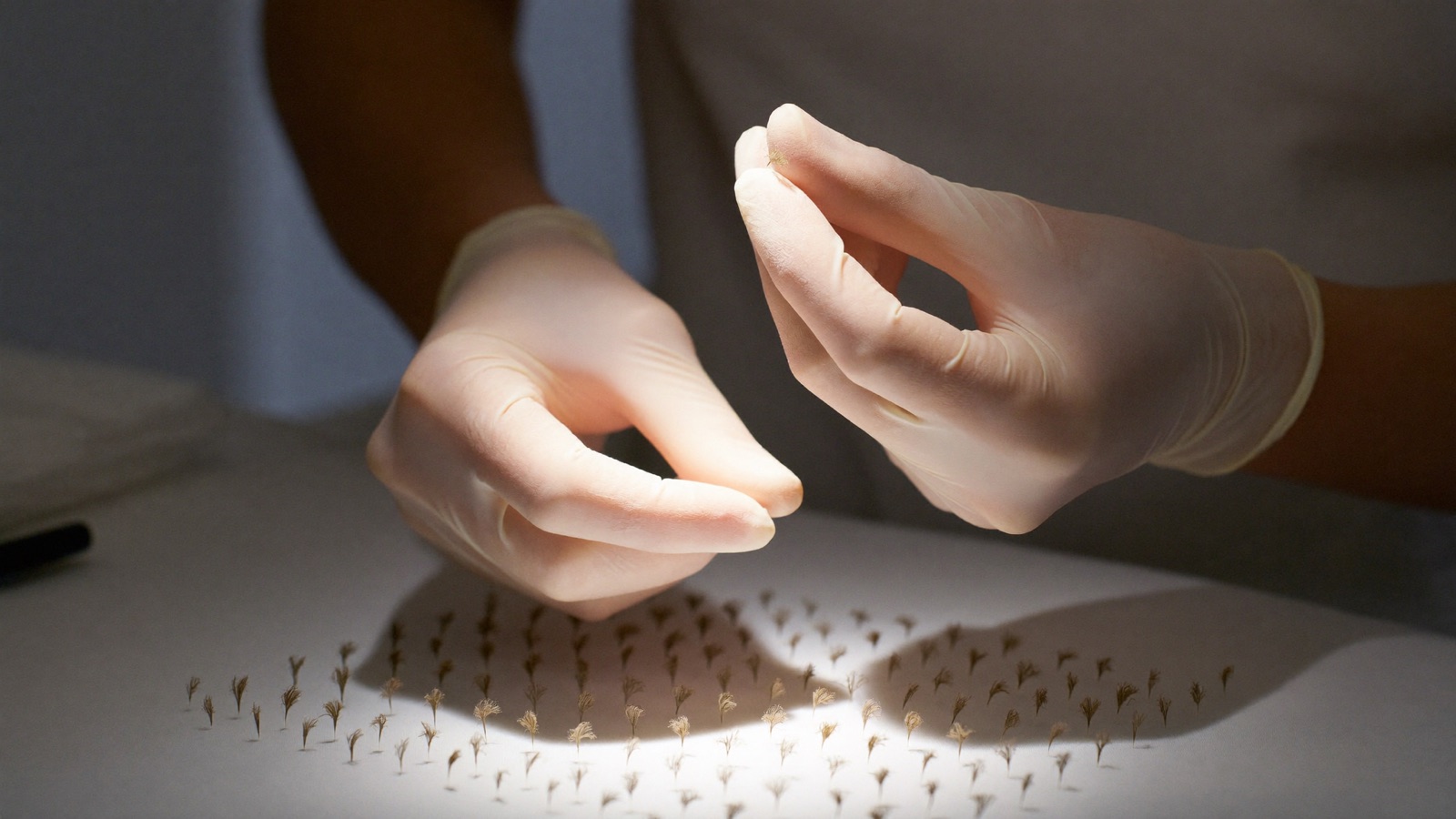
In manual FUE, the clinician scores around the follicular unit with a hand-held punch, then uses fine forceps to gently ease the graft out. The grafts are placed directly into a chilled storage solution and sorted under magnification.
The Graft Handling Question: Desiccation and Transection
Two things can harm a graft between the donor area and the recipient area: transection and desiccation.
Transection means cutting through part of the follicle during extraction. It happens when the punch is not aligned with the follicle, goes too deep, or meets a follicle that curves beneath the skin. Transection is mainly a matter of punch size, alignment and depth, which depend on the operator rather than on whether suction or forceps are used to collect the graft.
Desiccation means drying out. Follicles are delicate, and exposure to air can damage them. This is why careful clinics keep grafts moist and cool at every stage, and limit how long they spend outside the body.
Some surgeons have raised questions about whether air flow in suction systems could expose grafts to more drying, or whether pulling grafts through tubing could stress them. Others report that with careful settings and well-maintained equipment, suction-assisted extraction handles grafts well. Independent evidence comparing the two approaches is limited, so it is fair to treat graft handling as a question to ask any clinic, whichever method it uses.
| Factor | NeoGraft (suction-assisted FUE) | Manual FUE |
| How the graft is scored | Motorised punch, guided by hand | Hand-held punch, manual or motorised |
| How the graft is collected | Suction through tubing into a chamber | Fine forceps, placed directly into storage solution |
| Speed | Can be efficient for collection, depending on the team | Depends on team experience and workflow |
| Graft handling | Depends on suction settings, equipment care and time to storage | Depends on forceps technique and time to storage |
| Operator dependence | High: punch size, angle, depth and selection are human decisions | High: punch size, angle, depth and selection are human decisions |
| Recipient sites and placement | Usually by hand; some systems offer assisted placement | By hand |
Speed Advantages and Where They Come From
Speed is one of the most common reasons clinics give for using suction-assisted devices. Collecting grafts by suction can save the step of picking each graft out with forceps, which may shorten the extraction stage.
Faster extraction can be helpful, because shorter procedures are easier for patients and can reduce the time grafts spend waiting. But speed only helps if quality stays the same. Taking grafts quickly from the wrong places, or too densely from one zone, can leave the donor area thin. And speed at extraction does not shorten recipient site creation or placement, which are usually the most time-consuming and skill-dependent parts of the procedure.
An experienced manual team can also work efficiently. The real question is not which method is faster in theory, but whether the team treating you works at a pace that keeps quality consistent from the first graft to the last.
Why Device-Assisted Systems Are Popular With High-Volume Clinics
Device-assisted systems are attractive to some clinics for practical reasons. They can make the extraction stage more standardised, they can help newer team members contribute to procedures, and the device brand itself can be used in advertising.
None of this is a criticism of the device. NeoGraft is used by many clinics, and experienced teams achieve good results with it. However, it is worth understanding that a well-known device name can sometimes be promoted more heavily than the qualifications and experience of the people who will operate it. When the device is the main message, it is reasonable to ask who will actually be performing each step.
The same applies to other technology labels. Our guides to manual FUE versus robotic FUE and sapphire FUE versus standard FUE look at how robotic extraction and sapphire blades are marketed, and what matters more than the tool in each case.
Operator Skill as the Dominant Variable
Whether extraction is manual or suction-assisted, the quality of a hair transplant depends on decisions that a device cannot make:
- How many grafts to take. The donor area has a finite supply. A careful plan takes only what can be removed while keeping the back of the head looking full. Nova Medical does not overharvest grafts.
- Where to take them from. Spreading extractions evenly across the safe donor zone avoids thin patches.
- Punch size, angle and depth. These determine how cleanly each graft comes out, and they need to be adjusted to your hair type.
- Hairline design. A natural, age-appropriate hairline is a matter of judgement and experience.
- Recipient site creation and placement. The angle, direction and distribution of grafts decide whether the result looks natural.
This is why two clinics using the same device can produce very different results, and why the experience and supervision of the team matter more than the brand of equipment.
What To Ask a Clinic That Promotes a Specific Device
If a clinic leads with a device name, these questions help you understand what will happen in your procedure:
- Who will perform the extraction, and who will create the recipient sites and place the grafts?
- Who oversees the procedure from start to finish, and what are their qualifications?
- How do you keep grafts moist and cool between extraction and placement?
- How long are grafts typically outside the body before they are placed?
- What punch sizes do you use, and how do you adjust them for my hair?
- How many grafts do you recommend, and how much of my donor supply will that use?
- Can I see before and after results from your team for patients with hair like mine?
Clear, specific answers are a good sign. If answers keep returning to the device instead of the team and the plan, it is worth asking more questions before you decide.
What Recovery Looks Like After Either Method
Patients often ask whether NeoGraft changes the recovery. In practice, recovery after suction-assisted FUE and manual FUE follows the same general pattern, because both remove grafts with small round punches and both rely on recipient sites made in the area being restored.
In the donor area, each extraction leaves a tiny round opening that forms a small scab and closes within a few days. Once the hair grows back, usually over two to three weeks, the marks are typically hard to see at normal hair lengths. How visible they are later depends mainly on punch size, how evenly the extractions were spread and how many grafts were taken, not on how the grafts were collected.
In the recipient area, small crusts form around each graft and usually wash away by around day ten to fourteen. Most transplanted hairs shed between weeks two and eight, new growth starts around months three to four, and the result continues to mature for twelve to eighteen months. Aftercare instructions, such as gentle washing, avoiding pressure on the grafts and limiting strenuous exercise for a short period, apply in the same way to both methods.
The practical takeaway is that recovery is shaped by the size of the procedure and the care taken during it. Choosing a device-assisted or manual method does not, on its own, shorten or lengthen the time it takes to see your result.
How Nova Medical Approaches Extraction
Nova Medical uses manual extraction as part of the Nova Medical FUE Protocol. Each follicular unit is scored with a hand-held micro-punch under magnification, with punch size, angle and depth adjusted to the patient's hair, and then gently removed with fine forceps.
Grafts are placed into a chilled storage solution as they are extracted, then sorted and inspected under magnification before placement, with time outside the body tracked throughout. Recipient sites are created by hand at angles that follow the natural direction of growth, and grafts are placed with finer single-hair grafts along the hairline.
This approach was chosen because it adapts well to different hair types, including curly, coarse and grey hair, and because it keeps every graft under direct observation from extraction to placement. It is a description of how we work rather than a claim that other methods cannot produce good results. Every procedure is overseen by Dr. Martin Jugenburg, a Royal College-certified plastic surgeon (FRCSC).
The bottom line: NeoGraft is a tool for collecting grafts, not a separate type of hair transplant. Whatever device a clinic uses, the experience of the team, the care taken with each graft and a donor plan that respects your limits will shape your result far more than the equipment.
Comparing Clinics and Techniques?
A private assessment with Dr. Martin Jugenburg (FRCSC) explains how your grafts would be extracted, handled and placed, and how many your donor area can safely provide. No cost and no obligation.